

By Martin Hammer
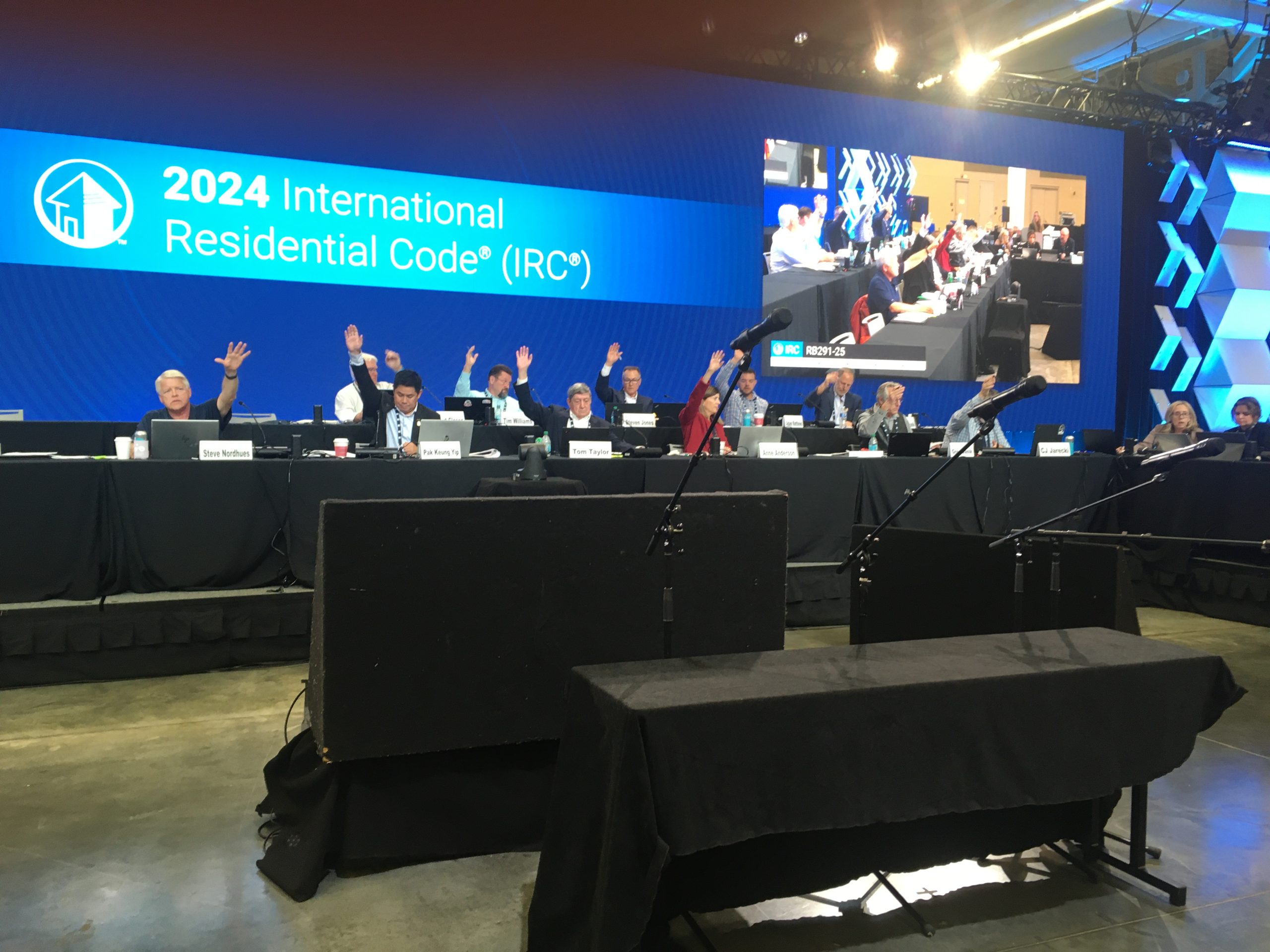
Natural Building code experts received two approvals and one thumbs-down for appendix updates submitted for approval at the International Residential Code Committee Week in Cleveland last month.
Berkeley, CA-based code experts Architect Martin Hammer (myself), Anthony Dente of Verdant Structural Engineers and others submitted updates for two bio-based building appendices (hemp-lime and straw bale) and tiny houses on wheels proposed as permanent dwellings Oct. 22 and 23.
1-Hour Fire-Rated Hemp-Lime Walls Approved
Appendix BL – Hemp-Lime (Hempcrete) Construction in the International Residential Code (IRC) saw significant advancement at code development hearings in Cleveland. Myself, Anthony Dente of Verdant Structural Engineers, and hemp-lime builder Cameron McIntosh of PA-based Americhanvre testified before the 11-member IRC Committee on behalf of their code change proposal to include three fire-tested hemp-lime wall assemblies in the 2027 IRC. The proposal received unanimous approval.
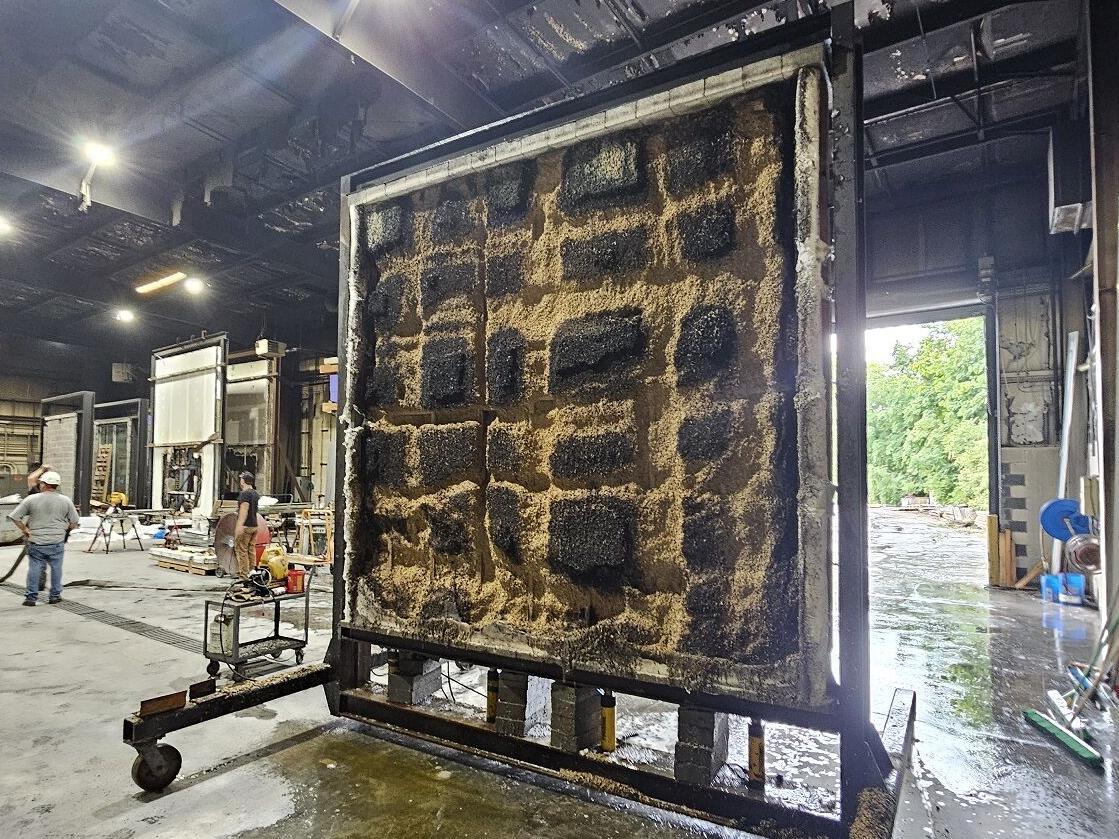
McIntosh facilitated ASTM E119 tests of three hemp-lime wall assemblies at Intertek Laboratories in York, PA in 2024 and 2025. Each assembly used a different wall framing configuration that appears in Appendix BL and that is commonly used in practice. Each assembly passed a 1-hour test, including a hose-stream test.
Inclusion of these rated walls in Appendix BL will simplify permit approval and reduce costs for hemp-lime projects that are required to use a 1-hour wall – for example when an exterior wall is closer than 5 feet to a property line, or for a wall separating a garage from the dwelling.
In addition, the 1-hour tests and ratings demonstrate the inherent fire-resistance of hemp-lime walls. This is of particular benefit in areas subject to wildfires, or to potentially help secure homeowners insurance or lower premiums.
The approval in Cleveland follows the approval of three other hemp-lime code change proposals in May at hearings in Orlando, FL. The proposal and testimony team consisted of myself, code consultant David Eisenberg, and hempcrete designer/builder Tim Callahan of Callahan Home Designs.
Two proposals improved or corrected code language in the 2024 Appendix BL, while a third importantly clarified that hemp-lime has passed a “surface burning characteristics” test (ASTM E84) that is required in the IRC for all insulation materials. Hemp-lime has twice achieved the test’s lowest possible score of zero for flame-spread index and smoke developed index. One test was facilitated in 2020 by Hempitecture, Inc., and the other by American Lime Technology. Both tests were conducted by Intertek. Stating hemp-lime’s compliance in Appendix BL potentially eliminates the time-consuming and costly need to conduct another test for a new hemp-lime project.
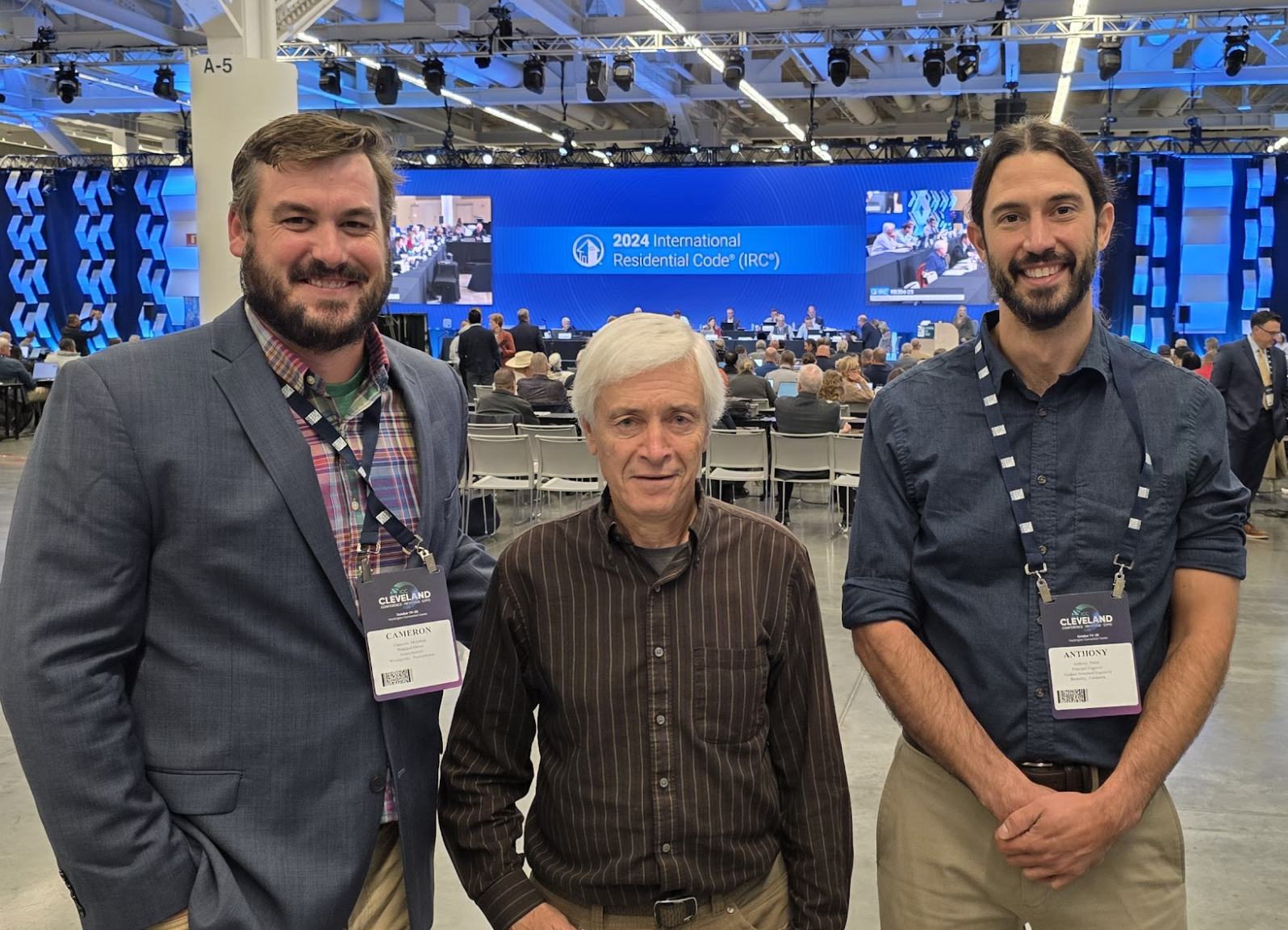
Natural building code warriors pose at the Cleveland ICC Committee meeting [L-R] Cameron McIntosh, Martin Hammer, Anthony Dente
Several Updates Approved for Strawbale Construction
The current IRC code development cycle also saw updates to Appendix BJ – Strawbale Construction (previously Appendix AS in the 2021 IRC). In Cleveland the use of plywood and other panel materials over straw bales was approved, with climate zone dependent requirements regarding vapor permeability. This helps safely facilitate the increasing use of conventional shear walls for strawbale walls.
Another approved proposal allows an “analytical method” prescribed in the IBC to determe the fire-resistance rating of a strawbale wall assembly. This helps permit variations of the two tested strawbale walls described in Appendix BJ (one with clay plasters, and one with cement-lime plasters) without having to conduct another expensive ASTM E119 test.
Other proposals were approved in Orlando, FL in May, including a) plasters installed in accordance with the appendix are considered air barriers, b) lime plaster is prohibited over clay plaster unless a history successful use is demonstrated, and c) clarifications for the curing of clay, clay-lime, and soil-cement plaster for compressive strength tests in structural strawbale walls.
The proposal and testimony team for the strawbale proposals consisted of myself, David Eisenberg, and Anthony Dente.
Movable Tiny Houses Tentatively Disapproved for Appendix BB
In Cleveland a proposal that would allow for movable tiny houses (also known as tiny houses on wheels) as a permanent dwelling was disapproved by a narrow 6-4 vote. The proposal was submitted by tiny house advocate Macy Miller, myself (co-author of the original Tiny Houses appendix), David Eisenberg, Anthony Dente, architect James Herndon, and tiny house advocates Jewel Pearson and Vera Struck. Several IRC Committee members in Cleveland expressed strong support for the proposal, but others justified their disapproval on unclear procedural grounds.
Using tiny houses on a chassis as a permanent dwelling, when anchored to the ground or a foundation, remains a much-needed code provision. Movable tiny houses are being manufactured and lived in nationwide, but owners and building officials continue to grapple with non-existent or piecemeal pathways to legalizing them. The proposal team is considering resubmitting a modified version of their proposal to be considered at the final Public Comment Hearing in Spring of 2026.
Notes on the IRC, its Appendices and Their Adoption
The IRC is the US national model residential code (for one- and two-family dwellings and townhouses) and is the basis for the residential code in 49 of the 50 US states. It is updated on a 3-year cycle. The 2027 IRC will become effective as early as 2028 in some states, depending on their adoption process and frequency (every 3 years, or 6 years).
Appendices in the IRC require explicit adoption by state or local jurisdictions to be enforceable, though even if not adopted, permit applicants can propose use of Appendix BL to the local building official on a project basis. The first US jurisdictions to adopt or approve for adoption the 2024 Appendix BL are the City of Austin, TX, (effective July 10, 2025) and the State of Minnesota (effective date TBA).
Address any questions to Martin Hammer via email: mfhammer@pacbell.net


